HomeInsightsLaser Cut Stainless Steel: Choosing the Grade, Thickness and Edge Finish
Laser Cut Stainless Steel: Choosing the Grade, Thickness and Edge Finish
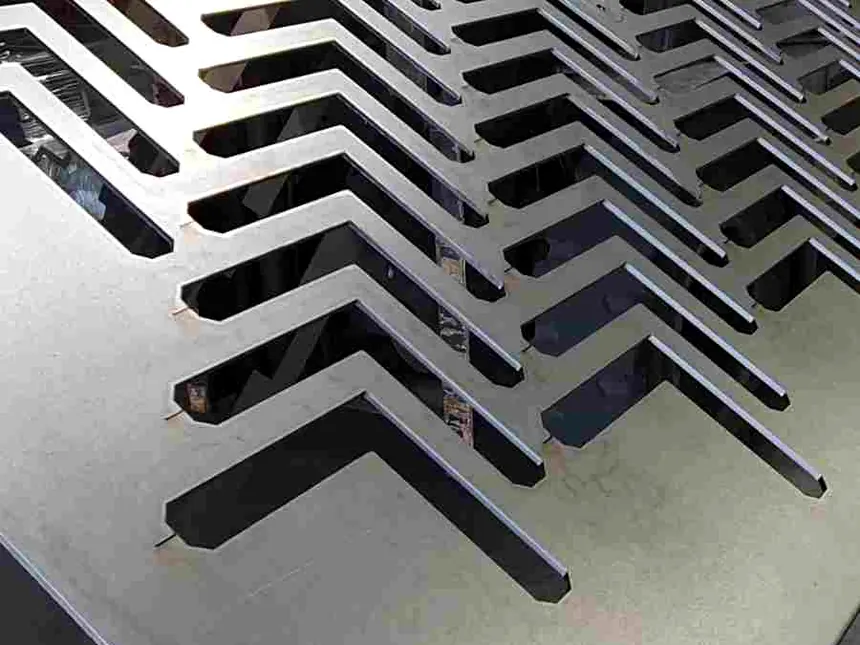
Laser cut stainless steel is sheet or plate profiled by a laser, usually with nitrogen as the assist gas so the cut edge comes off clean and bright with no oxide layer. At GF Laser in Dudley we cut stainless steel from 0.5mm up to 12mm in 304, 316, 430 and Hastelloy, held to +/- 0.25mm as standard.
That is the short answer. The rest of this guide covers the decisions that change the price, the lead time and how your part performs once it leaves the laser.
Which stainless steel grade should you laser cut?
Grade is the first decision, and it is usually set by where the part will end up.
304 stainless steel
304 is the general purpose austenitic grade. It suits enclosures, brackets, catering equipment and architectural trim used indoors or in mild outdoor conditions. It folds well on a press brake and is the grade most buyers start with.
316 stainless steel
316 contains molybdenum, which gives it better resistance to chlorides. That makes it the usual choice for marine, coastal, chemical and medical work. It costs more than 304, so it is worth specifying only where the environment calls for it.
430 and specialist grades
430 is a ferritic grade. It is magnetic, lower in cost and common in appliance panels and decorative work where corrosion demands are moderate. For harsher chemical environments we also cut Hastelloy, and other grades are available on request.
We hold 304 and 316 in stock, and less common grades and thicknesses can usually be sourced on a next day basis from our suppliers.
How thick can stainless steel be laser cut?
On our Trumpf fibre lasers the range runs from 0.5mm to 12mm, on sheets up to 4000 x 2000mm. Thin gauge stainless cuts quickly and holds fine detail well. As thickness rises, cutting speed drops and the smallest practical hole gets bigger, so a design that works in 2mm may need a rethink at 10mm. Holes that are too small for the plate can come out conical or incomplete, so check small features with the estimator before you finalise the drawing.
If the part has already been formed, such as a pressing or a bent tube, it goes on our 5-axis machines instead, which cut stainless steel up to 8mm.
Does nitrogen or compressed air give a better edge?
Nitrogen is the standard assist gas for stainless. It keeps oxygen away from the cut, so the edge stays bright and free of oxide. That matters if the part will be welded, left bare or used somewhere hygiene counts. Compressed air is a lower cost option that can suit parts where the edge will be hidden or coated, but it does not give the same bright finish. If you are unsure, tell us how the part will be finished and we will recommend the right gas.
What surface finish and protection do you need?
Stainless sheet comes in a range of finishes, including 2B and DP1, and plastic coated sheet is also available. The plastic film protects a visible face from scratches during cutting, folding and handling, then peels off once the part is in place. For decorative or architectural stainless, ask for coated material at the quoting stage, because it changes what we order.
For aerospace and medical assemblies that cannot tolerate oil or residue, our industrial parts washing service cleans components after cutting so they arrive ready to assemble.
What tolerances can you expect on laser cut stainless?
Our standard tolerance is +/- 0.25mm, held across stainless without any special arrangement. Tighter work to +/- 0.1mm is available with prior technical approval, so talk to us before you commit the drawing. For automotive and regulated work, our quality team produces PPAP and ISIR documentation along with CMM inspection reports.
Can stainless parts be cut, folded and finished by one supplier?
Yes, and it saves time and handling. Once the blanks are cut, our sheet metal bending service folds them on Amada press brakes up to 4 metres long, in the same building as the lasers. We also drill and tap stainless parts, so a bracket can leave us cut, folded and ready to fit.
How fast can stainless steel be laser cut?
Our standard flatbed lead time is three working days. When a line has stopped, our 24 hour laser cutting service runs on three shifts so expedited stainless parts can be turned around within 24 hours in most cases.
Getting your stainless parts quoted
The quickest route to an accurate price is a DXF, DWG or STEP file with the grade, thickness, quantity and finish noted. A PDF or sketch is fine too, as our CAD team can work from it. Send your drawing through our stainless steel laser cutting page or call 01384 245095, and we will come back with a price and a date within 24 hours. All of our work is carried out under ISO 9001:2015 and EN 1090 approval.
Frequently asked questions
What is the thickest stainless steel you can laser cut?
We laser cut flat stainless steel up to 12mm thick. Formed stainless parts such as pressings and bent tube can be cut up to 8mm on our 5-axis machines.
Is 316 better than 304 for laser cut parts?
316 resists chlorides better than 304, so it suits marine, chemical and medical work. For most indoor and general engineering parts, 304 does the job at a lower cost.
Can you cut a single stainless steel prototype?
Yes. We cut anything from a one-off prototype to production batches, although a minimum order charge may apply to small jobs.
Insights
- Tube Laser Cutting Services: Why Bent Tube Should Be Cut After Forming
- What Metals Can a Metal Laser Cutting Service Cut? A UK Buyer's Guide
- Subcontract Laser Cutting in the UK: When Does Outsourcing Make Sense?
- CNC Folding Services in the UK: How to Get Bent Sheet Metal Parts Right First Time
- Flatbed Laser Cutting Service or 5-Axis? How to Tell Which Your Part Needs
- How much is it to get something laser cut?
- Accurate laser cutting: what is actually possible?
- Should I choose laser cutting or CNC machining?
Not sure it is possible?
Send the file anyway. If we cannot cut it we will usually know why, and often know who can.
Send a drawing